Curacao Casino Licence UK: What It Means
 Available in GB
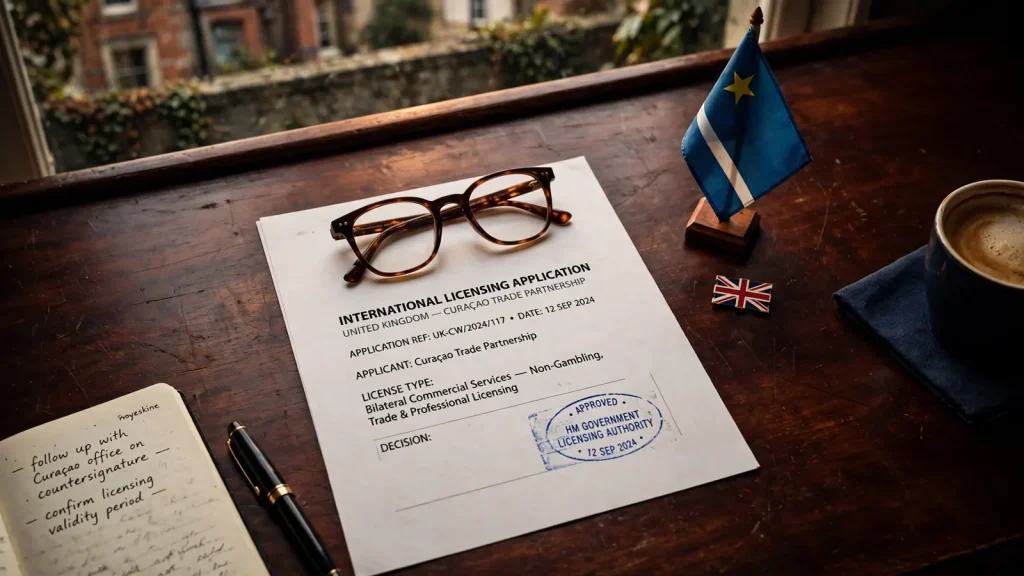
A Curacao licence identifies a licensing jurisdiction, but does not guarantee a shared set of games, payment options or terms.
Table of Contents
- What “Curacao Casino” Means for UK Players
- UK Law: The Operator’s Position and Yours
- Can a Curacao Casino Accept UK Players?
- How to Read a Casino’s Licence Claims
- Curacao Gaming Licences and What They Do—and Don’t—Tell You
- GamStop, Self-Exclusion and Player Safeguards
- Payments, Crypto and the Withdrawal Trade-Off
- Bonuses and Slots: Check the Terms Before You Play
- Are Curacao Casinos Legit and Safe?
- Safety
What “Curacao Casino” Means for UK Players
A “Curacao casino” is an online gambling site associated with a licence from Curacao. The phrase describes the jurisdiction connected with the operator’s licence; it is not a separate type of casino game or a guarantee about how a site works. For a UK reader, the broader category is a non-UK-regulated casino: an online gambling site that operates without oversight from the UK Gambling Commission.
That distinction helps make sense of descriptions such as “Curacao online casino” or “casino licensed in Curacao”. They point to a licensing jurisdiction, not to a common set of games, payment options or terms. Two sites described in the same way may still differ in what they offer and how they present themselves. The shared label is about regulatory location, not a uniform product.
Curacao in the wider picture
Curacao is one of several jurisdictions associated with online casino licensing. Malta, Gibraltar and Anjouan are other examples. These names can appear in descriptions of non-UK-regulated casinos, but they refer to different places; they are not interchangeable names for one regulator or one licensing system.
If you’re considering a casino associated with a Curaçao licence while in the UK, check the operator’s licensing and terms carefully. The details below give you one confirmed point to consider for each listing: its stated payout speed.
1. EvoSpin
Payout speed: 1-3 business days EvoSpin has a stated payout speed of 1–3 business days, giving you a specific timeframe to consider.
2. Chanze
Payout speed: 1-3 business days Chanze lists a payout speed of 1–3 business days. You can use this stated timeframe as one point in your review.
3. Zombillion
Payout speed: 1-3 business days Zombillion’s stated payout speed is 1–3 business days, a practical detail for you to note.
4. Amunbet
Payout speed: 1-3 business days Amunbet lists payouts as taking 1–3 business days. This is the available confirmed detail for you to consider.
5. BeOnBet
Payout speed: 1-3 business days BeOnBet has a stated payout speed of 1–3 business days, which gives you a clear timeframe to bear in mind.
6. Britsino
Payout speed: 1-3 business days Britsino’s listed payout speed is 1–3 business days. You can take this timeframe into account when reviewing the operator.
7. Dieselwin
Payout speed: 1-3 business days Dieselwin states a payout speed of 1–3 business days, a useful detail for you to note.
8. NightLuck
Payout speed: 1-3 business days NightLuck lists payouts at 1–3 business days. This stated timeframe is the available point for you to consider.
9. x3bet
Payout speed: 1-3 business days x3bet has a stated payout speed of 1–3 business days, giving you a specific timeframe to keep in mind.
10. NightWin
Payout speed: 1-3 business days NightWin lists a payout speed of 1–3 business days. You can consider this stated timeframe alongside the operator’s terms.
| Jurisdiction | How it fits the terminology |
|---|---|
| Curacao | One jurisdiction that may license online gambling operators |
| Malta | Another jurisdiction that may license online gambling operators |
| Gibraltar | Another jurisdiction that may license online gambling operators |
| Anjouan | Another jurisdiction that may license online gambling operators |
The table is a map of terminology, not a ranking. A jurisdiction’s name tells you where a licence may come from; it does not, by itself, tell you what games a particular site offers or how its service compares with another casino.
What the label does—and does not—identify
“Curacao casino” is often used as shorthand for a casino whose operator is connected with Curacao licensing. In ordinary discussion, that can be easier than naming the full operator and its licensing details. But the shorthand can blur two separate things: the website a player sees and the jurisdiction associated with its licence.
A casino brand is the public-facing service. The licensing jurisdiction is a regulatory label attached to the operator. Those may be discussed together, but they are not the same thing. If a site describes itself as Curacao-licensed, that description is a claim about its licensing context; it does not turn every other feature of the site into a Curacao standard.
This is why “Curacao casinos online” is best understood as a broad category rather than a specific kind of casino. The phrase can encompass different websites, with different layouts, game selections and terms. The jurisdiction is the common thread in the label, not proof that every site within the category offers the same experience.
Casino without a UK Licence: Rules and Risks
The same care applies to phrases such as “best Curacao online casino”. “Best” only means something once the comparison criterion is clear. A player prioritising a particular game selection may judge sites differently from someone focused on another feature. The Curacao label alone cannot settle that comparison; it identifies a jurisdictional association, not a winner.
Why the UK qualifier matters
When people refer to “Curacao casinos for UK players”, they are combining two different descriptions. “Curacao” points to the jurisdiction associated with licensing; “UK” identifies the audience they have in mind. The combined phrase does not create a separate class of licence. It is still a way of talking about a non-UK-regulated casino in relation to UK readers.
Keeping those parts separate prevents a common misunderstanding: a casino’s place in the wider international market is not the same as its identity as a UK-regulated service. The label gives context. It does not describe every practical detail of the casino or make different operators equivalent.
For a reader comparing the terminology, the clearest distinction is therefore between the site and the jurisdiction associated with it. “Online casino” names the kind of service; “Curacao” names the licensing location being invoked. Malta, Gibraltar and Anjouan can appear in the same broader conversation, but each is a separate jurisdiction.
That is the basic meaning of a Curacao casino in this context: an online gambling site associated with licensing from Curacao, considered within the wider group of non-UK-regulated casinos. The label is useful for identifying the category. It is not a complete description of the operator.
A Curacao casino is a non-UK-regulated online gambling site associated with a licence from Curacao, rather than a specific type of game or a guarantee of uniform service standards.
UK Law: The Operator’s Position and Yours
The legal question changes depending on whether you are looking at the gambling business or the person placing a bet. Under the Gambling Act 2005, the central licensing duty falls on operators that supply gambling services to the British market. A company does not avoid that duty by locating its headquarters or servers overseas: if it serves customers in Great Britain, it must hold the relevant licence from the UK Gambling Commission.
That rule is about the operator’s permission to provide the service. It is not a rule that makes a player responsible for obtaining a gambling licence before using a site. The Act is aimed at businesses supplying gambling, rather than individual customers who use them.
What the law says about players
UK law does not expressly make it unlawful for a British citizen to use a gambling service licensed in another country. More specifically, a player who gambles on a site without a UK licence does not commit a criminal offence under UK law simply by placing a bet there.
That distinction matters when you see a Curacao casino described as “illegal”. The word may refer to the operator’s position in the British market: a foreign licence is not a substitute for the UK Gambling Commission’s permission to serve Great Britain. It does not, by itself, mean that a British player has committed a crime by accessing the service.
Nor should the absence of a player offence be mistaken for approval. A Curacao casino licence does not give an operator authority to serve British customers under UK rules. The player’s position and the operator’s licensing obligation are separate issues, not two ways of describing the same legal test.
Merkur Casino Online UK: Games and Site Checks
Great Britain and the wider UK
The relevant operator requirement in this context concerns Great Britain: England, Scotland and Wales. The Gambling Act 2005 does not govern Northern Ireland, so the position should not be assumed to be identical across every part of the United Kingdom. If you live in Northern Ireland, consider the local legal framework rather than treating rules for Great Britain as a complete answer.
For customers in Great Britain, the practical distinction is straightforward. A business may hold a foreign gambling licence, but that alone does not satisfy the UK requirement for an operator serving the British market. Conversely, the fact that a site is not licensed by the UK Gambling Commission does not turn an individual player’s use of it into a criminal offence under the Act.
This is why “Can the operator lawfully offer the service here?” and “Can the player be prosecuted merely for using it?” need separate answers. For the first, the operator must have the appropriate British licence when serving Great Britain. For the second, UK law does not impose a criminal offence on the player simply for gambling on an unlicensed site.
Different sides of the line.
The distinction is narrow but important. It tells you where the UK licensing duty sits; it does not certify a foreign casino, endorse its terms, or guarantee that using it will be straightforward. A licence from Curaçao or another jurisdiction and permission from the UK Gambling Commission are not interchangeable credentials. The legal exposure described here is about the operator’s obligation and the player’s criminal liability—not whether a particular site is authorised to accept customers in Great Britain.
Legal Status
While gambling on an unlicensed site is not a criminal offence for the player under UK law, the operator itself may be acting illegally by serving the British market without a UK Gambling Commission licence.
Can a Curacao Casino Accept UK Players?
A Curacao casino website may be accessible from the UK, but that does not establish that its operator is authorised to serve customers in Great Britain. The key distinction is between being able to open a website and being permitted to offer gambling to people in the market.
For an operator serving customers in England, Scotland or Wales, its location does not change the requirement: it needs a UK Gambling Commission licence. A licence from Curacao does not replace that requirement. So a site describing itself as a Curacao casino for UK players should not be treated as authorised on the strength of that description alone.
Website access is a separate matter. A page may load, display games or allow you to start registration without confirming that the operator is entitled to serve you. Nor does a payment option, including cryptocurrency, settle the question. The relevant issue is the operator’s authorisation for the market, not whether the site is technically reachable or which currency it accepts.
There is another distinction to keep in view: the operator’s own terms. A site may restrict who can register or play, and its rules may not match what a visitor assumes from the site’s language or availability. Do not infer permission from a UK-facing page, a pound symbol, or the fact that a form appears to accept your details. Those are not substitutes for the required authorisation.
Searches for Curacao casinos accepting UK players can also blur two different meanings of “accepting”. A website might allow a visitor to proceed, while the operator is not authorised to serve customers in Great Britain. Conversely, an operator’s licence terms may exclude a customer even if the website remains viewable. Accessibility is not approval.
The same distinction applies to a Curacao crypto casino. Using crypto does not change the operator’s licensing position. A different payment method cannot turn a Curacao licence into a UK Gambling Commission licence, and the presence of a crypto option says nothing by itself about whether the operator is authorised for Great Britain.
Non-UK-regulated casinos may set more lenient deposit and withdrawal policies, which can mean fewer restrictions or faster payouts. That operational flexibility is a separate consideration from authorisation; it does not establish that a casino may serve the British market.
If a casino’s UK availability is unclear, treat that uncertainty as a reason not to assume it is authorised. The practical test is not whether the site works on your device, but whether the operator holds the required UK Gambling Commission licence to serve customers in Great Britain. A working page proves only that the page works.
How to Read a Casino’s Licence Claims
A licence badge is a claim to check, not a verdict. A casino may describe itself as Curaçao-licensed, and a directory may repeat that description, but neither statement alone establishes which company operates the site or which markets it is authorised to serve. Treat the operator’s identity, the licence information and the permitted markets as separate questions.
Start with the casino’s own legal pages. Look for the company name, the jurisdiction named as its regulator, and any licence number or link to a public register. Then compare those details with the relevant regulator’s records. A company name that differs from the one in the register, a missing reference, or a link that leads only to a general homepage leaves the claim unconfirmed. A logo is easy to display; matching details matter more.
Do
- Check the company name in the regulator’s public register
- Verify the licence number and expiry date
- Read the operator’s legal terms for market restrictions
Don’t
- Rely on a licence badge or logo alone
- Assume a site is authorised because the page loads
- Trust a directory’s simple tick as official evidence
Next, read the terms that identify the operator and describe where its service is available. A licence from one jurisdiction does not automatically mean permission to serve customers everywhere. The crucial distinction is between holding a licence and having authority to operate in a particular market. For customers in Great Britain, operators serving the market require a UK Gambling Commission licence, whatever their location. A foreign licence label does not replace that requirement.
The Anjouan example makes the point clearly: an Anjouan licence does not authorise an operator to serve the United Kingdom or other markets listed as restricted. That restriction is specific to Anjouan; it should not be treated as a description of Curaçao’s licensing system. The broader lesson is simply that the jurisdiction named on a badge cannot, by itself, answer where the operator may legally offer its service.
Be cautious with a Curaçao casino list or review page that presents licence status as a simple tick. A list may be useful for finding names, but it is not the regulator’s record and does not establish that an operator’s current details match an official entry. Reviews can also blend several separate matters—game selection, payment options, customer service and licensing—into one overall rating. If you are comparing a Curaçao-licensed casino with another site, keep the licence evidence in its own column rather than letting a positive review stand in for it.
The same discipline applies to searches for a Curaçao slot site or casinos said to accept Paysafecard. A payment method, game catalogue or polished website says nothing by itself about the operator’s licence or market permissions. Check the company behind the site and the exact wording of its legal terms rather than inferring authorisation from the features advertised.
For an Anjouan casino, compare the company and licence details with the public register, including the entry’s expiry information, before relying on the claim. For a Curaçao operator, use the relevant regulator’s records and the operator’s own legal disclosures, but do not assume that a process or restriction described for Anjouan applies there. The criterion is a match between the named company and verifiable licensing information—not the number of directories repeating the same badge.
A careful check can establish what a licence claim says and whether its details line up. It cannot turn a foreign licence into permission for a different market. One badge, one question.
Curacao Gaming Licences and What They Do—and Don’t—Tell You
A Curacao gaming licence can tell you that an operator claims a connection to a licensing framework outside the UK Gambling Commission. It does not, by itself, tell you how closely that operator is supervised, what standards it must meet, or what remedy you would have if something goes wrong. Those are separate questions, and a licence label cannot answer all of them.
The same distinction applies when a site describes itself as a Curacao eGaming casino or appears on a list of Curacao-licensed online casinos. The wording is not a complete account of the oversight behind the service. A rating or directory entry may help you identify a claim, but it cannot establish the quality of the regulator’s requirements or the practical protection available to you. The useful comparison is not simply “licensed” versus “unlicensed”; it is what the relevant regime requires and what it can do when a dispute arises.
A licence label identifies a regulatory relationship; it does not guarantee that the oversight is identical to the protections provided under the UK Gambling Commission.
What a licence can indicate
Licensing is a form of oversight, but the content of that oversight depends on the jurisdiction and its rules. A licence may indicate that an operator is expected to comply with requirements set by an authority. It does not automatically mean that every regulator imposes the same requirements, checks the same things, or provides the same route for complaints.
That matters when you compare Curacao casino ratings. A high rating may reflect a reviewer’s criteria, not a regulator’s enforcement record. Likewise, a licence claim is not a universal quality mark. To judge what it means, you need to distinguish the existence of a licensing framework from the protections that framework actually delivers.
For a UK Gambling Commission-approved regime, the key difference is that the regulator’s rules apply to operators serving customers in Great Britain. A UKGC-approved service also sits within a system that includes responsible-gambling requirements and access to an independent dispute resolution route for eligible complaints. That does not make every dispute simple or guarantee a particular outcome. It does mean the operator is answerable within a UK regulatory structure, rather than leaving you to rely only on the operator’s own process.
Safe Online Casinos in the UK: Licence and Checks
A Curacao gambling licence should not be treated as a substitute for that structure. The word “licensed” describes a regulatory relationship; it does not say that the relationship offers protections identical to those under UKGC oversight. The practical question is what obligations apply to the operator and what authority can act if those obligations are not met.
Why the jurisdiction matters
Anjouan provides a useful comparison because its framework illustrates how much can differ between licensing systems. Under that framework, casinos are not required to have random number generators tested, undergo audits, or keep player funds segregated. The Anjouan authority also does not investigate, mediate, or decide player complaints.
Those limits should not be attributed to Curacao: they describe Anjouan’s framework. The point is that the word “licence” alone does not tell you whether a regime requires independent testing, financial controls, or a regulator-led complaints process. Each jurisdiction must be understood on its own terms.
This distinction is easy to lose when a site presents a seal, a licence number, or reassuring language about regulation. Such details may identify a claim, but they do not establish that the underlying regime provides the same protections as the UK system. Nor does a jurisdiction’s reputation, by itself, show what an individual operator is required to do.
What the label cannot settle
A Curacao casino licence does not settle whether the operator is authorised to serve customers in Great Britain. That is a different issue from whether it holds a licence somewhere else. It also does not tell you, on its own, whether the service has the safeguards you expect from a UKGC-regulated casino.
The same caution applies to a Curacao-licensed crypto casino. A cryptocurrency payment option changes how money may be transferred; it does not strengthen the licence or expand the regulator’s powers. A payment method and a regulatory framework answer different questions.
When assessing a licence, separate three criteria: the jurisdiction named, the obligations imposed by that jurisdiction, and the route available to you if the operator fails to meet them. The first is a label. The other two determine how much that label is worth in practice.
Assessing Licences
To evaluate a licence, distinguish between the jurisdiction named, the actual obligations imposed, and the available route for dispute resolution.
A licence can be relevant. It is not the whole answer.
GamStop, Self-Exclusion and Player Safeguards
GamStop is the UK Gambling Commission’s self-exclusion scheme. A casino that is not part of it will not be covered by a self-exclusion you registered through GamStop. This is the key practical difference for anyone considering Curacao casinos outside GamStop: the exclusion does not provide the same barrier across those sites.
That does not mean a casino is “exempt” from GamStop in the sense of having an approved alternative arrangement. It means the site is outside the scheme. If you have self-excluded because gambling is causing harm, an account at a non-UK-regulated casino may remain accessible even while your GamStop exclusion is active. Do not treat the absence of a block as permission to gamble or as evidence that your self-exclusion has ended.
What you cannot rely on
UKGC-licensed operators must provide responsible-gambling tools under the UK regime. At non-UK-regulated casinos, those protections may be less stringent. You should not assume that a site will offer the same mandatory tools, apply the same standards, or respond to a request in the same way.
In particular, do not rely on a Curacao casino to apply your GamStop exclusion, or assume that a limit or restriction set with one operator will carry over to another. Controls offered by an individual site, where available, are not a substitute for a scheme that covers participating UK operators. The distinction is simple; the consequences are not.
The UK’s Financial Ombudsman Service is also not available to players in the same way when they use offshore casinos. If a dispute concerns how a site handled your account or a request to restrict play, you cannot assume that the UK service will review it. Nor should you expect access to the UKGC’s mandatory responsible-gambling tools through an operator outside its system.
That leaves you with less dependable support at the point when you may need it most. A casino may describe its own limits or account controls, but a statement on a website is not the same as a UK-wide self-exclusion scheme or a comparable independent route for resolving a complaint.
If you are already self-excluded
If you joined GamStop to stop or reduce gambling, the safer course is not to open an account at a site outside the scheme. Do not use a new Curacao casino, or a site described as not signed up to GamStop, as a workaround. A new brand does not change the fact that it is outside the exclusion you registered.
If you are unsure whether an operator is covered, do not infer it from the site’s name, its location, or a claim that it has responsible-gambling features. Those details do not establish that GamStop applies. The relevant point for this section is whether the operator participates in the scheme; without that coverage, your GamStop exclusion does not extend to it.
If you have already started gambling and want to stop, avoid making a deposit while you try to establish what controls the operator offers. You can contact a support organisation such as GamCare or GambleAware for help thinking through next steps. Seeking support is not dependent on a casino’s own policies.
GamStop Risk
Non-UK-regulated casinos are outside the GamStop scheme, meaning your self-exclusion does not provide a barrier to access on these sites.
A practical way to assess the risk
Before considering any non-UK-regulated casino, ask yourself what would happen if you wanted to stop playing. Would you be relying on GamStop, a site’s own account settings, or your ability to contact its customer service? Those are different levels of protection. A site-specific control may apply only there, and its terms may not provide the same coverage as a UK scheme.
Also consider your information and account data. Non-UK-regulated casinos may follow less stringent data-protection rules than UKGC-licensed operators. Read the site’s privacy and account terms before sharing personal details, and do not assume the UK standards you may be used to apply in the same way.
The deciding criterion is not whether a casino advertises a self-exclusion option. It is whether the protection you need actually covers the operator and gives you a route to act when you want to stop. If you depend on GamStop, a casino outside the scheme does not meet that criterion.
Payments, Crypto and the Withdrawal Trade-Off
A deposit method is only half of a payment decision. The useful comparison is whether the same route can be used for withdrawals, how long a payout may take and whether limits force you to collect a balance in instalments. A method shown at checkout does not, by itself, confirm that withdrawals will be available through it.
Non-UK-regulated casinos may support bank cards, e-wallets, bank transfers and cryptocurrency, sometimes using payment processors other than the familiar UK services. If you are looking for Skrill, Neteller or Trustly, check the individual cashier’s current deposit and withdrawal options rather than assuming that a name appearing on a payment page applies to both. Available methods can differ between funding and cashing out.
Crypto can provide another way to move funds, and it can bypass the UK ban on gambling deposits funded by credit cards. That does not settle the practical questions: check which currencies and networks the cashier accepts, whether conversion is involved, and what the operator says about withdrawals. A supported deposit route is not a promise of a matching payout route.
Published withdrawal estimates do not agree. One account gives a range from 24 hours to five business days, depending on the payment method; another warns that a payout may take three or four weeks, with no regulatory clock to enforce a deadline. Treat the faster estimate as a possibility, not a reliable delivery date. Verification requests, payment processing and the casino’s own handling can all affect the wait.
A specialist review also reports that some non-UK-regulated casinos set daily, weekly or monthly withdrawal limits. Where such a limit applies, a large balance may have to be paid out in instalments. This is not a universal condition, so look for the limit in the cashier rules and withdrawal terms before depositing. Check whether the cap applies per transaction or across a stated period, and whether it differs by payment method.
For a practical comparison, note the deposit route, available withdrawal route, stated processing time and any cash-out cap. The winner depends on what you value: a familiar payment service may matter more to you than a faster stated estimate, while clear withdrawal terms may outweigh a wider choice of deposit methods. Read the small print.
Bonuses and Slots: Check the Terms Before You Play
A headline bonus is not its spendable value. For Curacao casino bonuses, the useful comparison is the amount you can withdraw after meeting the conditions—not the size of the offer shown on the page. Before accepting, check what the wagering requirement applies to, which games count, when the offer expires and whether a cash-out cap applies.
Evaluating Bonuses
- Identify the wagering base (bonus, deposit, or both)
- Check which specific games contribute to the requirements
- Verify the expiry date for claiming and wagering
- Confirm if there is a maximum cash-out cap on winnings
A specialist review reports that offshore welcome offers can carry wagering requirements of 35x or more. The multiplier alone does not tell you the total task: terms may apply it to the bonus, the deposit and bonus together, or another stated amount. Read the offer’s own terms to identify the calculation base. If that is unclear, the advertised figure is not enough to compare offers.
Free spins need the same scrutiny. A specialist review reports wagering requirements of 30–50 times the winnings, alongside withdrawal caps of £5–£50. It also reports that free-spin packages can expire within 24–72 hours. These are reported terms, not a promise that every casino uses them; the offer in front of you may differ. Check the expiry and cap before activating spins, since winnings subject to a low cap may have little practical value.
| Term | What to establish |
|---|---|
| Wagering base | Is the requirement calculated on the bonus, deposit and bonus, or winnings? |
| Eligible games | Do the slots you want to play count, and do different games contribute differently? |
| Cash-out cap | Is there a maximum withdrawal from bonus or free-spin winnings? |
| Expiry | When must you claim the offer, use the spins and finish wagering? |
For Curacao casino slots, check whether a bonus is restricted to particular games. A promotion may not cover every title in the casino’s lobby. Book of Dead and Starburst are familiar examples of named slots, but seeing a game listed does not establish that it contributes fully—or at all—to a promotion’s wagering requirement. The offer terms decide that.
A useful comparison is therefore not “which site has the biggest bonus?” but “which offer has the clearest terms for the games I intend to play?” If the wagering base, eligible slots, expiry or withdrawal cap is difficult to find, treat that uncertainty as part of the cost. Fine print is still the offer.
Are Curacao Casinos Legit and Safe?
“Legit” can mean two different things: that a site is a genuine business, and that it is authorised to serve customers in Great Britain. A Curacao licence claim does not, by itself, settle either question. For a UK player, the practical test is whether the operator holds the required UK Gambling Commission licence; without it, you do not have the protections attached to a UK-regulated service.
Casino Safety & Access: Licensing and Account Checks
Safety is less straightforward. A licence label alone cannot tell you how player money is handled if an operator fails, or what route is available if you dispute a decision. Those details matter more than a polished website or a prompt customer-service reply. No label is a substitute for enforceable protection.
Anjouan provides a specific cautionary comparison, not a description of Curacao’s rules. Under the Anjouan framework, casinos do not have to keep player funds separate from company funds. If an operator fails, players may be unsecured creditors, which can leave them with a weak position in recovering money. The framework also does not provide an independent dispute-resolution route comparable to UKGC-approved services. Operators must respond to complaints within 30 calendar days, but a response is not the same as independent adjudication.
Those Anjouan conditions should not be attributed automatically to a Curacao-licensed casino. Equally, they show why “licensed” is not a complete answer to whether a site is safe. Check what the specific operator’s terms say about funds, complaints and withdrawals, and consider what happens if the operator does not resolve a dispute. If the service is outside UK regulation, you cannot rely on UK complaint routes to resolve it.
So, are Curacao casinos safe? There is no responsible blanket yes or no. A site may be genuine, but that does not establish the strength of its player protections. If access to UK-regulated safeguards and a recognised dispute route is your deciding criterion, a non-UK-regulated casino is the weaker choice.
Are gaming sites not on GamStop permitted for UK players?
Yes, you are not committing a criminal offence under UK law simply by gambling on a site outside GamStop. However, sites serving customers in Great Britain need a UK Gambling Commission licence, and casinos outside the scheme do not provide GamStop self-exclusion.
Can UK players legally play at casinos licensed in Anjouan?
Yes, you do not commit a criminal offence under UK law simply by placing a bet with an Anjouan-licensed casino. But an Anjouan licence does not authorise the operator to serve customers in the UK; operators serving Great Britain need a UK Gambling Commission licence.
What is the biggest risk of playing at a non-UK-regulated casino?
A key risk is having less protection if something goes wrong: Anjouan-licensed casinos do not offer an independent dispute route comparable to UKGC-approved services, and player funds are not guaranteed to be segregated. If the operator fails, you may be an unsecured creditor.
Safety

Anjouan Casino Licence in the UK: Scope and Limits
An Anjouan authorisation identifies its licensing framework, but does not establish permission to serve UK...

Best Casino App UK: Compare App and Browser Play
The guide weighs app availability against browser access, licensing, payments, bonus conditions and game performance...

Best Foreign Casinos for UK Players: What to Know
Understand how overseas licensing affects legality, player protections, bonuses, withdrawals and access to self-exclusion tools....

International Casinos for UK Players: Laws and Limits
An overseas licence does not authorise an operator to offer online gambling in Great Britain;...

Mobile Casinos That Accept Phone Credit in the UK
This guide explains carrier billing, potential costs, deposit limits and why withdrawals use a separate...

Offshore casino sites for UK players: what to check
An offshore operator may accept British customers without a UKGC licence, affecting oversight, terms and...

Best Offshore Casinos for UK Players: What to Check
Understand how licensing, access from the UK, bonus conditions, payment methods and verification affect the...

British Casinos Not on GamStop: Licensing and Safety
A practical look at licensing, responsible-gambling tools, bonus terms and withdrawals at casinos described as...

Casino Sites Not Registered with GamStop UK: What to Know
GamStop applies to UKGC-licensed online casinos; this guide explains how to check licensing, terms, payments...

Casino no ID verification in the UK: what it means
The guide separates quick sign-up from waived checks and explains how licensing, payments and withdrawals...

Casino without a UK Licence: Rules and Risks
A UKGC licence is distinct from permission issued elsewhere, and that difference affects oversight and...
Casinos That Bypass GamStop: UK Rules and Risks
A guide to the scheme’s UKGC boundary, offshore licensing, bonus conditions and the risks of...

Gibraltar Casino Licence in the UK: What to Check
A practical comparison of offshore casino claims, payment terms and the UK licensing question, with...

Merkur Casino Online UK: Games and Site Checks
Merkur-branded slots appear in casino lobbies, but the operator—not the game—controls the account, deposits and...

Trustworthy Online Casinos in the UK: What to Check
A practical trust check starts with the business providing the gambling service and whether it...

No Account Casinos in the UK: What to Check
The label describes an access route, not a licence or an exemption from age and...

No-ID Verification Withdrawals at UK Casinos
“No verification” may refer to when checks occur, not whether they happen; payment methods and...

Non-Gamban Casinos in the UK: What It Means
A site’s availability through a blocking tool does not verify the operator; the article explains...

Non-GamStop Curaçao Casino Sites: What the Label Means
A Curaçao label does not establish an operator’s location, oversight, or permission to offer gambling...

Non-GamStop European Casinos: UK Exclusion Explained
A European casino’s location or branding does not establish whether it is covered by UK...

Non-UK Licensed Casinos: How Their Licences Work
A licence may come from a regulator outside the UK, so its jurisdiction matters when...

Non-UK Registered Casinos: Regulation and Safety
The guide explains how licensing jurisdiction, UKGC oversight and site terms affect protections, payments and...

Non-UK Casinos: UKGC Rules and Player Protections
The guide explains how Great Britain’s licensing rules differ from offshore permissions, and what to...

Non-UKGC Casinos: How Offshore Licensing Works
The label means a site is outside UKGC oversight; any separate licence must be assessed...

Malta MGA-Licensed Online Casinos and UK Rules
An MGA licence reflects Malta’s regulatory framework, but operators serving Great Britain need the licence...

Online Casino No Registration in the UK: What to Know
Browser access can avoid a software download, but real-money play still involves operator checks and...

Online Casinos With No Sister Sites: UK Guide
Sister-site status depends on operator or platform links; similar layouts alone do not establish a...

Online Slots Not on GamStop: Licences and Protections
GamStop applies through participating UKGC-licensed operators; the casino, rather than the slot game, determines whether...

Safe Online Casinos in the UK: Licence and Checks
Assess UK casino safeguards, from licence verification and account protections to payments, game rules and...

Trusted Casinos Not on GamStop UK: What to Check
A practical way to assess licensing, bonus conditions, review claims and withdrawal checks at casinos...
Trusted UK Casinos: Licensing and Safety Checks
A UKGC licence links gambling services for Great Britain to their regulator, but payment, bonus...

USA Casinos for UK Players: Licensing and Risks
The label “USA” does not establish an operator’s location or regulatory status; UKGC licensing is...

VPN-friendly casinos in the UK: licensing explained
A casino's willingness to accept VPN connections does not make it UKGC-licensed or bring it...